Read three lighting instructions side by side
The skincare prompt specifies “soft window light from the upper left”: source, softness and direction are all named. The ceramics prompt specifies “warm morning window light, soft long shadows”: warmth and shadow length carry more of the mood instruction.
The stationery scene adds an overhead viewpoint and light from the top-left. Here, small shadows help distinguish paper edges on the same plane. In the room example, daylight instead connects objects at different depths.
Use the three examples to compare how lighting instructions support different subjects and arrangements.
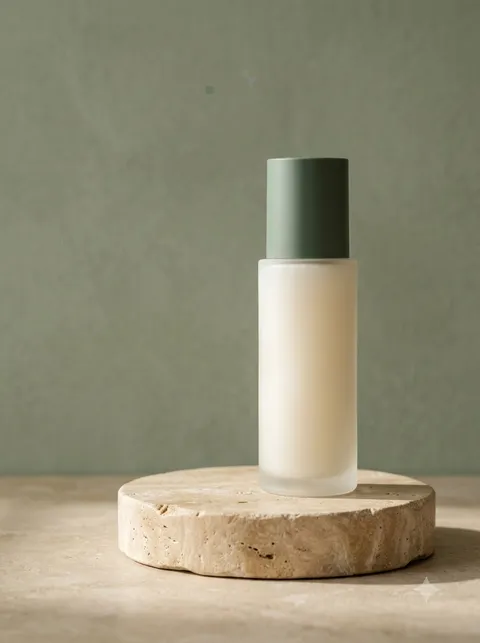
Skincare on limestone
Light from the upper left gives the bottle a lit side, a shaded side and a contact shadow on the pedestal.
Skincare on limestone
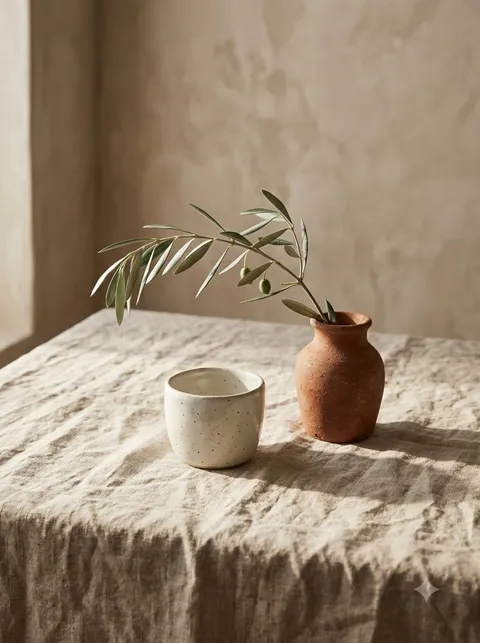
Morning ceramics
The warmth sets a colour impression, while long shadows describe the light geometry. The two instructions do different jobs; replacing one does not automatically replace the other.
Morning ceramics
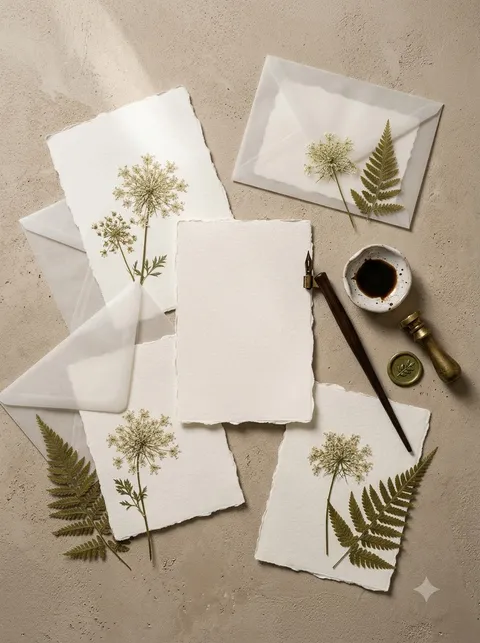
Botanical stationery
The overhead viewpoint puts the papers and tools on one plane. Arrangement, overlap and empty paper surfaces become more important than showing depth into a room.
Botanical stationery
Identify the main subject
Find the object or area that the prompt puts first. In the fragrance scene it is one bottle; in the breakfast it is the toast; in the reading nook it is the chair. Supporting details should help that subject remain readable.
Look for direction and softness
“From the upper left” describes direction. “Diffused” or “soft window light” describes a quality of the light. These are different decisions. Changing direction should affect shadows, while changing softness changes the transitions between lit and shaded areas. Generated results still need visual checking.
Read the camera instruction
An overhead flat lay describes a different organisation from a front-facing paper artwork. A close crop emphasises a surface, while a room view needs relationships between objects. Pick a viewpoint that suits the layout you plan to make.
Check space and background
A quiet backdrop and fewer props can leave useful space around the focal object. The precise position of that space should be requested if a later design needs a headline. Add final typography separately unless you are deliberately testing in-image lettering.
Compare your result
Choose the example closest to your brief, then inspect your result after each change.
Further reading: Google DeepMind's image prompting guide.